
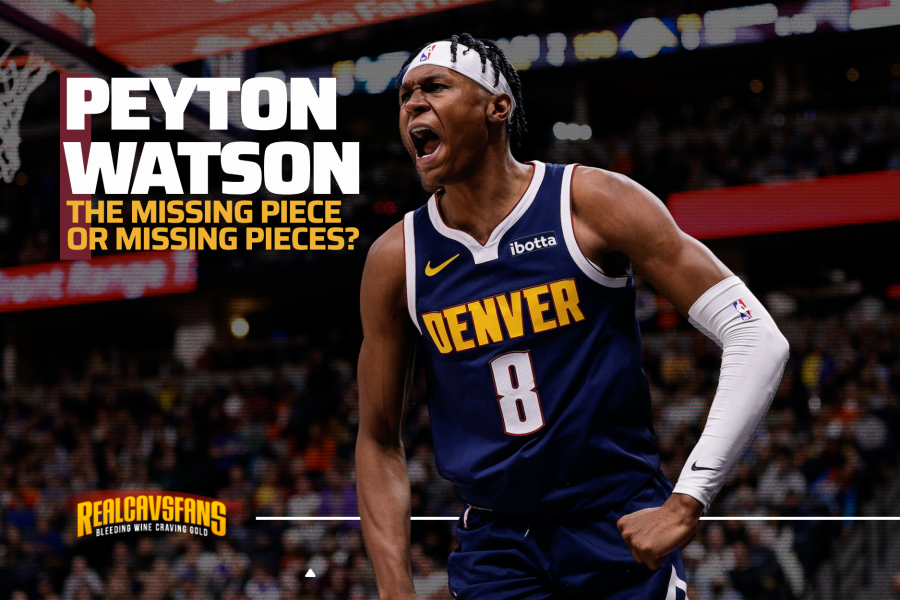
It took a while, but late offseason trades have become a bit of a Koby Altman staple – Lauri Markkanen in late August, Donovan Mitchell in early September and now Peyton Watson in mid-August. If Watson pans out like the previous two, the Cavs will be in good shape.
LeBron James escaped from Altman’s grasp, and two of the Cavs best perimeter defenders walked out of the door as a result of the pursuit – Dean Wade and Keon Ellis. The James move to Philly, along with Wade, left Altman needing to dig out of a Cleveland sized pothole after putting all of his eggs in the LeBron basket.
But, the optionality has been building since the deadline. First it was Darius Garland for James Harden which enabled the key financial flexibility to make this happen (shoutout to Harden for waiting, taking less and recruiting Watson). Then it was moving De’Andre Hunter for Dennis Schroder and Ellis, letting Ellis walk and getting off Schroder’s money (to Koby’s credit without giving up draft picks). And finally, it was finding a team willing to take on Max Strus’s salary that opened up enough room for Harden and Watson.
It’s hard enough to predict if LeBron would choose the Cavs or if they would have a realistic chance at Watson but Koby continually chose flexibility. The challenge is converting that flexibility as long-term flexibility usually requires a short-term cost and short-term risk. But when the plan comes together, it has a chance to pay off long-term.
So, will it pay off and what will it take for it to pay off? Let’s take a look.
The Finances
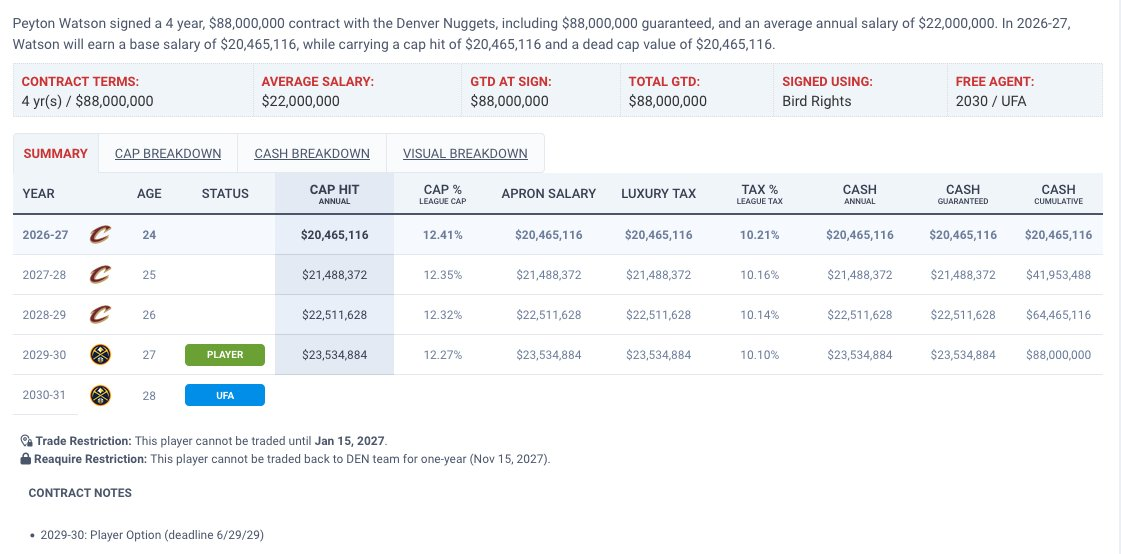
If Watson plays 65 games a year, and 30 minutes per game, Stephen Noh's salary model projects Watson to be worth approximately $72.8M over the next four years while his production last year was worth $13.3M.
Watson's $22M AAV puts him 105th in the league for average value of signed contracts and 42nd amongst forwards entering next season (right after Hunter ironically enough).
Watson's agent Rich Paul had an interesting take on Watson's deal essentially stating Watson's deal will look overpaid in year one, and partially in year two, but should start to look underpaid in years after that if he develops like they expect (and hope) he does. Which, is a fair point. The Cavs are paying Watson in hopes of what he can become not what he is right now.
But this is the price you pay for a 23-year old two-way forward... or the risk you take for a two-way forward on the upswing. The challenge is with the current window tied to Mitchell and Harden, they will need growth sooner rather than later as they look to capitalize on the two-ish year window in front of them.
The Fit
Let's start with where Watson fits in walking off the bus: defensively.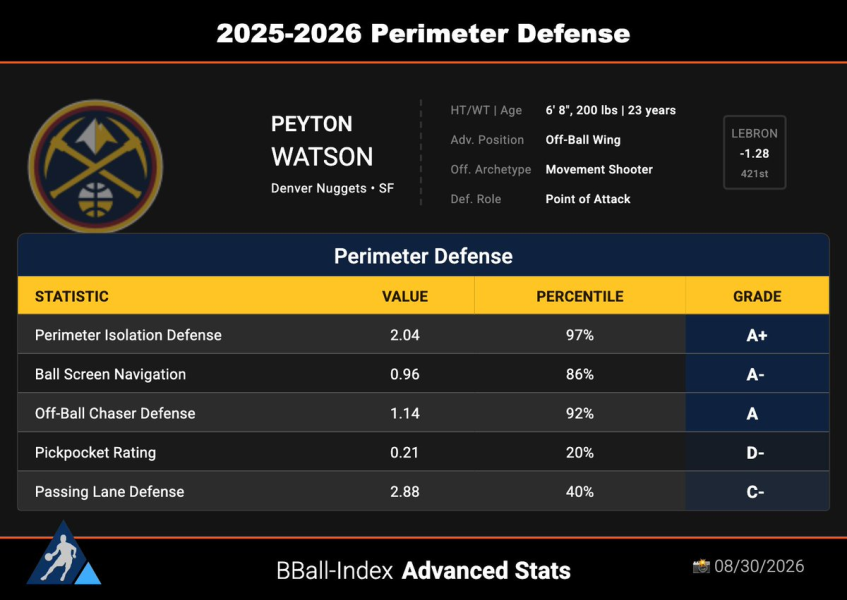
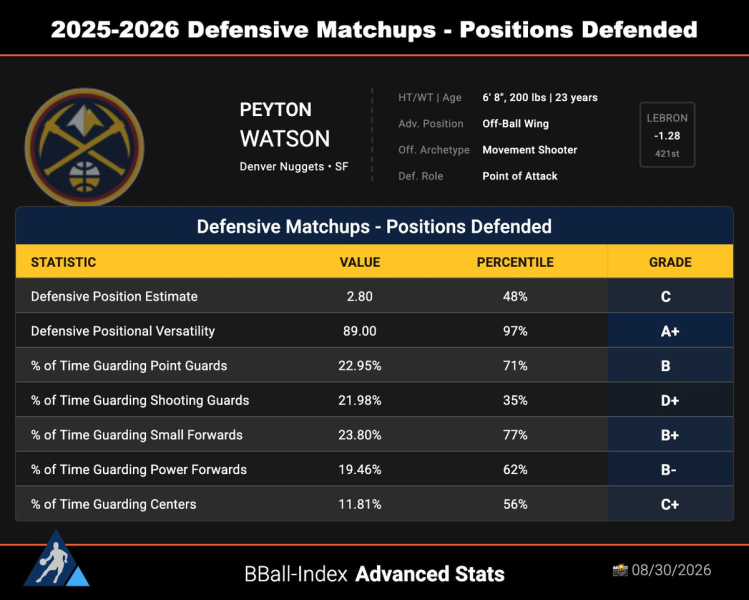
Watson's 97th percentile perimeter isolation defense and 97th defensive positional versatility speak to the primary role he'll play, and a large part of his value -- he's a strong POA defender that can guard a variety of different players and positions. The ability to be a strong one-on-one defender across multiple positions, and multiple player types, is critical when paired with this backcourt and has made the finding the right starting SF a challenge. There's not many players that can matchup against wings as well as they can against guards but Watson has that ability. Just in the playoffs alone Wade guarded Brandon Ingram, Scottie Barnes, Cade Cunningham and Jalen Brunson. For comparison, Wade's defensive positional versatility was in the 100th percentile (%tile). This year, that could mean guarding Nickeil Alexander-Walker and Jalen Johnson one series, and Tyrese Maxey and Jaylen Brown the next.
For his career, here's how Watson has fared against current East foes (per 75 possessions):
- Cunningham: 74 possessions, 17.2 PTS, 7.1 ASTs, 0 TOVs, 47.9% TS%, 4 FTA
- Pascal Siakam: 68 possessions, 14.3 PTS, 3.3 ASTs, 1.1 TOVs, 41.6% TS%, 6.6 FTA
- LeBron James: 64 possessions, 21.3 PTS, 4.1 ASTs, 1.2 TOVs, 44% TS%, 1.2 FTA
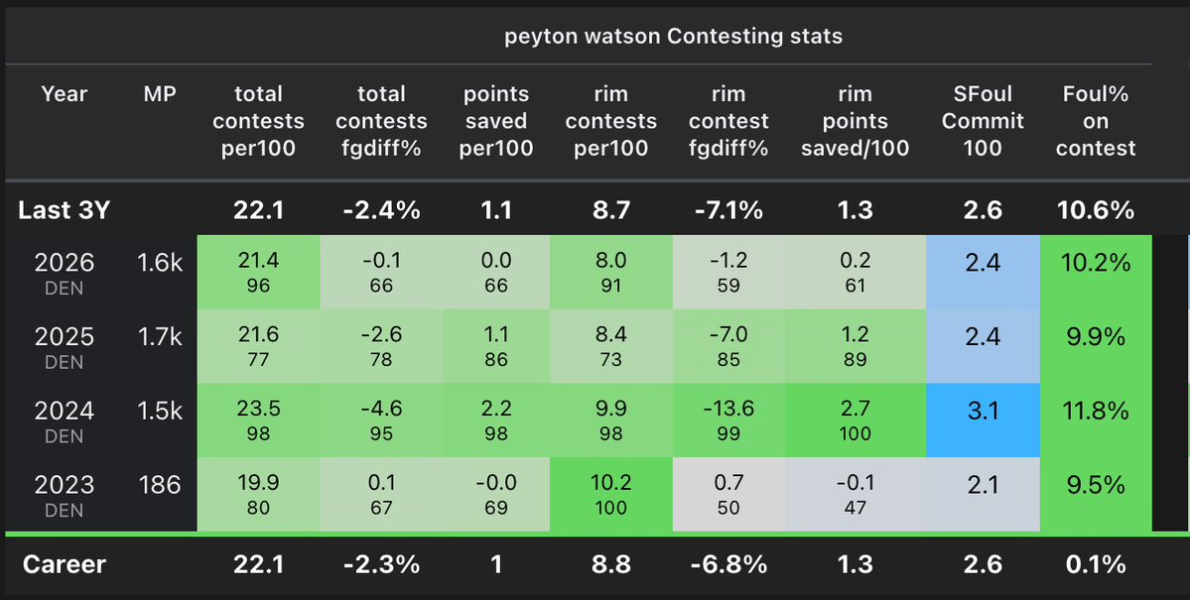
The other exciting part of Watson's defensive value is rim protection. He ranked 99th, 98th, 100th and 100th %tile in BLK% the last four years, and the above image showcases the impact he has in being a rim deterrent as well as being a rim preventer.
This is particularly impactful in three ways:
- In the starting lineup providing another layer of protection against Mitchell and/or Harden losing their matchup
- Being an added line of defense at the rim when Mobley or Allen are put into action away from the rim
- In transition to allow for Allen and/or Mobley to recover
There's also the defensive rebounding where his athleticism and size show up. While the previous two years were below average, last year Watson was 65th %tile in defensive rebound%. The Cavs' offensive rebound prevention has been a sore spot the last few years so further doubling down on being able to limit opponent possessions and opportunities is important. (For reference: Wade was 63rd %tile in defensive rebound% last year).
So, defensively the Cavs are getting a strong POA defender who offers versatility with elite rim protection and solid rebounding. What about offensively?
Watson's offensive game is a development but one spot he's showed the biggest strides in is shooting.
In his lone year at UCLA, Watson shot 22.6% from 3 on 2.8 3PA/36. This past year he shot 41.1% from 3 on 4.4 3PA/36.
The biggest jump, and greatest talent for Watson right now, is corner threes. They account for 16% and 13% of his total shot attempts the last two years and he converted at 45% and 52%. This efficiency, combined with some improvements on non-corner threes and in the midrange, helped bring his eFG% to the 68th %tile this year and account for lion's share of his offensive production. For a team that has two players in the top-5 in drive points added and an offensive philosophy that emphasizes drive-and-kick, having a player who can knock down spot-up corner threes will be beneficial to flow, spacing and effectiveness.
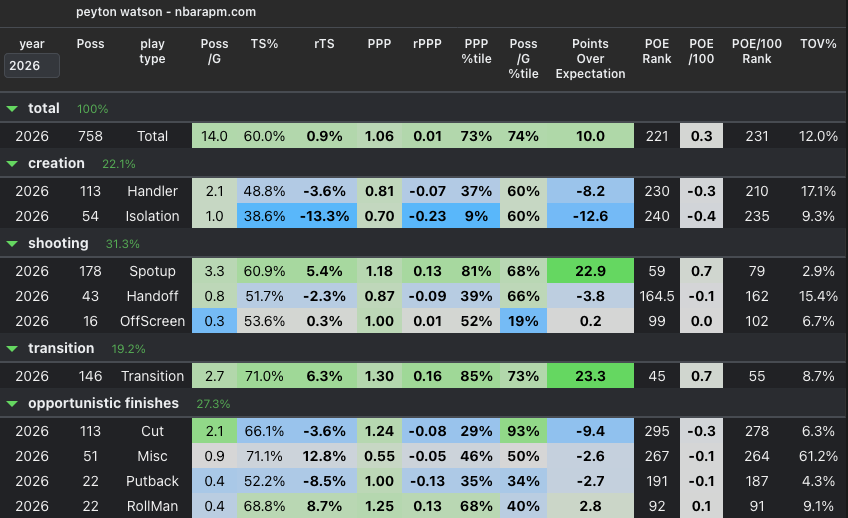
Watson's second best playtype last year was spot-up attempts. He ranked in the 81st %tile with 1.18 PPP (points per possession) and a rTS% (relative TS%; how much higher than the average did the player shoot) of 5.4%. This was the most common playtype for Watson last year accounting for 3.3 of his 14 possessions per game. It's a significant jump from the year before where he was 68th %ile with 1.12 PP with a rTS of 0.5% on 1.8 of his 7.9 possessions per game.
Right alongside spot-up in offensive efficiency is transition at 2.7 of his 14 possessions per game last year with a 85th %tile ranking. If you watch Watson highlights from last year, you can see him being a magnet to transition and getting out on the break at any opportunity. While the Cavs were 13th and 10th in pace the last two years, they ranked 17th and 19th in transition frequency. Watson's ability to get out and convert on the break could add a new wrinkle to the offense, and one that will force Harden, Mitchell and Mobley to look up early and often.
The other part of his game that still needs an improvement in efficiency (29th %tile) but was a large part of his offensive profile (2.1 of his 14 possessions per game) is cutting. Playing with Nikola Jokic will teach if you move, and move often, and you'll be rewarded. While Kenny can't replicate having Jokic on the team, let's hope he can replicate some of Denver's sets and take advantage of Watson's movement.
The part of Watson's game that flashed last year, and has people excited about his potential, is his on-ball development. He went from 10%-11% on-ball previously to 20% last year. In addition, his percentage of assisted shots went from 85% the prior year to 74% last year (50th %tile frequency, or average). The long midrange shot frequency also jumped from 3% to 8% of his shots and the accuracy jumped from 8% to 50%.
Watson is an efficient and effective off-ball player as shown in his spot-up shooting, cutting and transition numbers but his value offensively will explode if/when he can develop his own offense independent of what's happening on the floor. The Cavs don't need Watson to be Paul George (although it would be nice), they just need him to be enough of a threat to have respect him and anything on top of that is gravy.
The switch from Wade to Strus in the starting lineup during the playoffs highlights this very point. While Strus's spacing was important, so was his ability to make something happen with the ball in his hands which forced him to be guarded. Watson doesn't need to be the main flow, just an outlet valve.
One final note on his offensive game: His 32.5% free-throw rate (% of his shots coming from the free-throw line) would have ranked 5th on the Cavs last year (and just ahead of Mitchell). Watson is historically very good at drawing contract and getting to the free-throw line ranking in the 86th and 92nd %tile in shooting foul rates. The issue has been his conversion when he's gotten there (even though it's steadily improved year-over-year) -- capping out at 73% last year.
Individual skill set aside, the fit is also important within the context of the team.
Being 6'7" with a 7'1" wingspan is going to enable consistently larger lineups which is something the Cavs lacked last year as a lot of lineups felt small. And we've seen historically the best pairings with the bigs is size. Not only does it amplify their strengths but it also helps cover for smaller and weaker defensive backcourts.
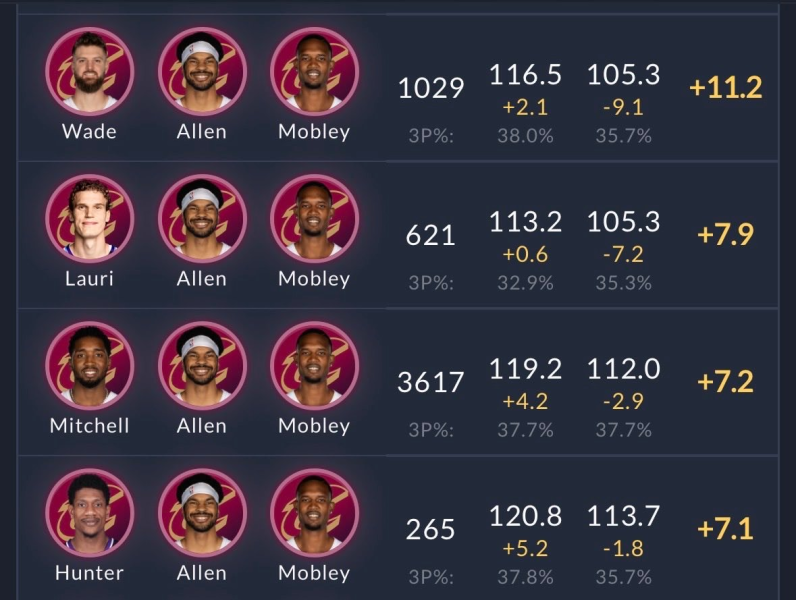
Watson averaged just under 30 minutes per game last year (and he should hover around that mark with the Cavs) with 56% of his minutes coming at the SF spot and 43% of his minutes at the PF spot. While Watson was brought in as the starting wing, he will likely see a share of minutes at the PF spot in secondary lineups to get the Cavs wing depth on the floor -- Jaylon Tyson, Sam Merrill and Mario Hezonja. Watson has spent a significant amount of time as small-ball 4 in Denver, and it's an even more meaningful positional versatility given the Cavs shallow backup big options. The Nuggets were 82nd %tile and 46th %tile in efficiency differential with Watson at the 4 the last two seasons. For reference: the Cavs were 82nd %tile efficiency differential with Strus at the PF spot last year, 57th %tile with Tyson and 48th %tile with Ellis.
Watson's size and athleticism will be an added bonus to a team that needs it. Too often last year it felt like Kenny was searching for size that he could keep on the floor without sacrificing something else -- shooting, defense, or rebounding, and could never find the right combination. The hope with Watson is he provides enough of everything to unlock better starting and closing lineups.
The Fixing
Here's where the work (or the concerns) come in.It's not all rosy defensively and there's a few things to keep in mind.
One: He's yet to translate his individual impact defensively to an overall team impact defensively. The Nuggets have consistently been below average with Watson on the floor defensively and better with him off the floor. This doesn't mean he's a bad defender but it does call into question why his defensive, and individual defense, reputation aren't showing up in team defensive impact metrics.
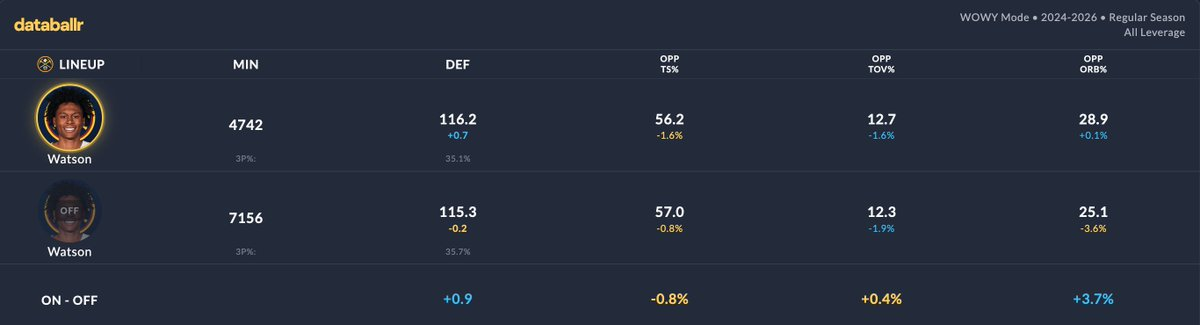
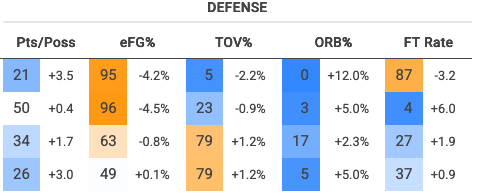
There's more to being an good defender than individual defense. We saw Tyson get pulled last year because of his off-ball lapses despite his one-on-one defense. Being a team defender means being in the right spot, at the right time, and someone teammates can count on to be part of the connective fabric. The weakside rim protection is there but the consistency and the little things defensively have to be there for Watson.
However, it does call into the question if POA defense doesn't portray as strongly in on/off numbers particularly if a player isn't particularly strong defensive event creators. Watson was 47th and 31st %tile in STL% the last two years and his defensive rebounding was 46th and 40th %tile prior to this year (65th %tile).
POA defense can sacrifice involvement in plays to which it may be right to ask if by nature it sacrifices overall defensive team impact.
Case in point: Other strong POA defenders with low defensive involvement markers also suffer from lower-than-average on/off defensive numbers despite strong defensive reputations.
- Lu Dort: 100 %tile perimeter isolation defense, 53rd %tile STL%, 40th %tile DREB%, 16th %tile defensive pts/100 poss
- Toumani Camara: 98th %tile perimeter isolation defense, 43rd %tile STL%, 45th %tile DREB%, 47th %tile defensive pts/100 poss
- Jaden McDaniels: 98th %tile perimeter isolation defense, 54th %tile STL%, 34th %tile DREB%, 50th %tile defensive pts/100 poss
- Andrew Wiggins: 96th %tile perimeter isolation defense, 52nd %tile STL%, 38th %tile DREB%, 32nd %tile defensive pts/100 poss
Now, two: Watson struggles with bigger, bulkier offensive players.
Watson is tall, athletic, and long but slender. He weighed in at 203lbs during the 2022 NBA Combine and is still listed at that in his NBA profile (which is hard to believe and probably incorrect).
In looking at defensive matchups over the last two years, several players showcase this issue: Anthony Edwards, Luka Doncic, Jalen Williams, and even Lauri Markkanen and Miles Bridges. The further up the chart the player is, the better their eFG% was against Watson compared to normally and the further right the player is the more shot attempts they had against Watson guarding them.
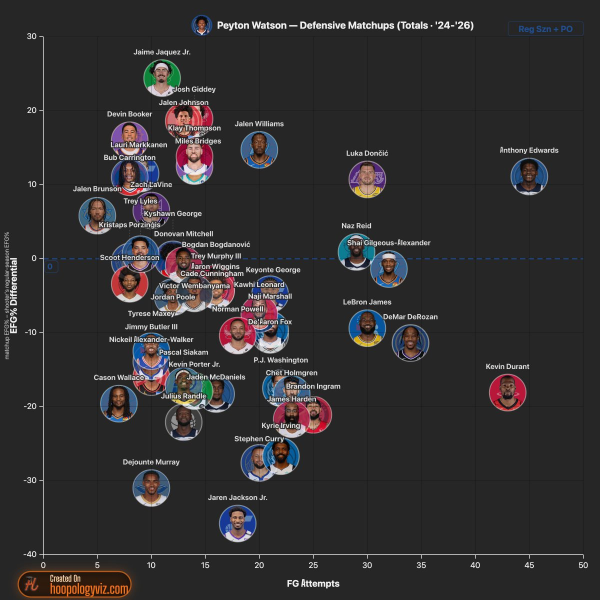
This isn't a fatal flaw but it may be a limitation to who Watson can guard (and where Tyson's defensive range and body type may be complementary). His history against Brunson has been limited but slightly below average; same for Jalen Johnson but with even more success against Watson. Jayson Tatum is still in the East and other matchups like Kawhi Leonard (which went slightly better than average in their history), Jaylen Brown and Franz Wagner await. It'll help to have Mobley and Allen behind Watson but there's still work to be done before a player gets to them.
Flipping to the other side of the ball is what can raise Watson's ceiling but also sink his ship.
The improvement in three-point shooting was great, and the off-ball stuff is valuable, but the efficiency is not where it needs to be.
The jump to respectable efficiency this year was driven by the improvement in the long mid-range area but mostly by the jump in corner three-pointers, otherwise...
Watson gets to the rim a bunch (76th, 98th, 73rd %tile the last three years in shot frequency) but doesn't finish a bunch (49th, 48th and 35th %tile the last three years) which is bit confusing with his athleticism. And even when he does generate contact to get to the line (86th, 92nd and 58th% tile in shooting foul percentage), he doesn't convert that well (22nd, 11th and 20th %tile in FT%). You could say he is creating a lot of efficient opportunities but struggling to finish in efficient ways.
The non-corner three progression has been relatively flat -- 34%, 24%, and 35%. The corner three is the shortest three on the court, which is why it has become popular amongst role players, but also speaks to Watson's three-point improvement being siloed and still needing to flesh out in other areas.
Which also gets to the three-point volume itself. This is the same discussion had with Wade and Isaac Okoro -- efficiency has its limits based on volume. Volume creates gravity more than efficiency does. Teams are not worried about a player who can hit 1 or 2 threes in a game even at a 40% clip. They're worried about guys who can hit 3, 4 or 5 threes in a game (even if it's at a lower clip). For their career, Wade is at 5.8 3PA/36, Okoro at 3.9 3PA/36 and Watson at 3.6 3PA/36 (4.4 3PA/36 last year).
Wade made 2+ 3Ps 8 times over the last two seasons. Okoro made 2+ 3Ps 10 times last year and 6 times the year before. Watson made 2+ 3Ps 9 times last year and 3 times the year before.
The efficiency for Watson has improved but the volume must follow (which is the inverse of his interior game).
Now, the Watson self-creation flashes are there but the efficiency is not (yet).
22.1% of his offensive plays were via creation this season which was a significant jump from 4.8% in 2025. But, that also came with a rTS% of -3.6% on ball handler plays and -13.3% on isolation plays this year. So more chances but less efficient. This is where tape (above) and off-season work combine to make a difference. Watson may not get these opportunities as much in the starting lineup but will get more of these opportunities in secondary lineups (which he will very much be a part of).
The other part of being on-ball is creation for others. So far, Watson isn't there.
Watson handled the ball more last year but it didn't translate to more shot creation. His AST% jumped from 7.3% to 9.4% but within the context of the time he spent on the ball his assist-to-usage ratio dropped from 28th %tile to 11th %tile. His TOV% also rose to a career high 13.1% (30th %tile); which is not unexpected as on-ball time increases but something to watch -- role players, especially as they scale, can't let inefficiency also scale with their opportunities.
For now, anything from Watson on-ball is a bonus but makes the difference between the $22M AAV looking like a good deal and a great deal.
The Finish
The Cavs will be asking Watson to do something he really hasn't shown he can do yet -- play a lot of high level basketball for a long duration.He's seen his games played decrease by year (80 to 68 to 54) and generated a discussion based on sitting out of the playoffs due to a hamstring injury that had whispers saying it was part of the reason Denver let him go.
His true production to this point also resides heavily from last year with most of it coming as a starter including a 15-game burner with Jokic out.
At a minimum, Watson must be a consistent three-point shooter with volume; show some motion on the ball; be an impactful POA defender with ancillary defensive support (blocks, deflections, etc); and bring the juice. Anything else will only make the Watson deal look more valuable, and anything less would make it look like a reach.
The Cavs reached the Eastern Conference Finals last year for the first time since 2018, and broken through a ceiling some doubted they could get to. Now, Koby took a swing on a two-way forward that has a high ceiling that in could turn punch through the next ceiling the Cavs are after.
Last edited:

